Pricing Model Restucture
Benchmark Email
SaaS
//
B2B Digital Marketing App
Transformed a paid usage plan into multi-lever tiered plans that delivered greater value and flexibility to SMBs

Summary
Polaris Software’s B2B digital marketing platform, Benchmark Email, serves SMBs globally in 9 languages. It offered freemium plans to new signups and a single paid plan with higher contact limits as its upgrade incentive, offering little feature differentiation between plans.
Problem: With contact limits as the only upgrade incentive, customers were reluctant to upgrade or convert because it didn't provide enough value to justify the cost.
Goal: Deliver more value to SMBs by restructuring the pricing model to offer affordable plans with independently adjustable feature packages and contact limits, driving upgrades and conversions as part of the company’s product-led growth strategy.
Impact Summary:
25%
increase in Pro plan conversion
50%
increase in Pro plan upgrades
↑
elevated in-app traffic to key conversion pages
80%
of features unified into a management system, lowering development time and cost
My Role
As Design Lead, I collaborated directly with the CPO, VP of Development, and lead engineers on high-level strategy. I also led the feature packaging team with a lead engineer, owning end-to-end processes as its sole designer while managing project execution and planning content. I drove design consistency and solution validation with the plan checkout product team and partnered with Marketing to align messaging across customer touchpoints.
Challenges
There were complexities with introducing feature packages that never existed before:
Unifying experience and feature control across fragmented legacy tech stacks
Creating business logic for feature packaging and feature loss/gain when moving between grandfathered and new plans
Designing flows and components for multiple types of feature limitations, upsells, and state-switching scenarios (e.g. restricted access, usage caps, limited trial access, etc)
Creating sub-account variations
Balancing message clarity and component flexibility across 9 languages
Tight project timeline
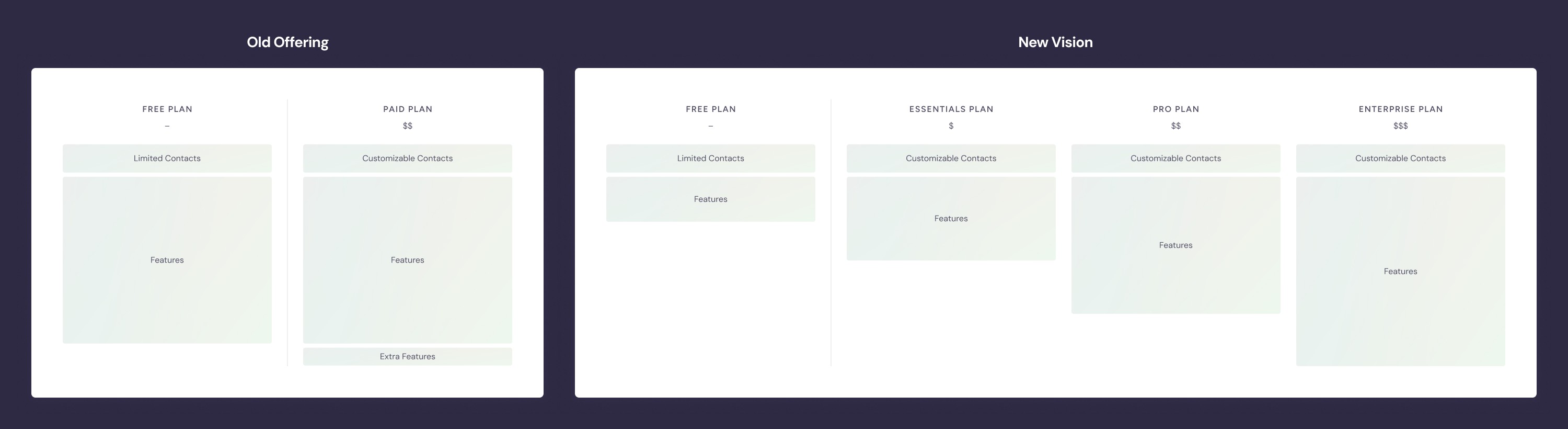
Old vs. new pricing structure
Approach
Geared feature packages toward target SMBs
To deliver value to each target persona, I analyzed interviews, customer data, and product usage with the CPO, weighing feature restrictions and their value against technical constraints and scalability.

Paid packages targeted specific SMBs
Validated with customers prior to launch
When validating upsell directions, I partnered with the plan checkout team to run usability tests on full upsell-to-checkout experiences, testing two feature limitation flows: restricted access and usage cap.
Findings showed customers understood the limitations and upsell prompts, but also revealed friction with the transition from upsell to plan selection page and tier differentiation confusion on the plan selection page. Both were iterated on prior to our second round of testing and again before launch, with plan differentiation continuing to be refined post-launch.
Solution
Transformed a single paid plan into three paid tiers with distinct feature packages

Created feature packages and their upsell flows for three separate paid plans, partnering with the plan checkout team to unify the experience

Cohesive system across all feature limitation types and state-switching
Balanced user clarity with monetization goals
Designed and placed upsell prompts at natural workflow moments to create feature awareness and opportunity without disrupting workflows (above: usage cap)

Personalized experiences by interchanging components based on plan and account type across all supported languages

Unified disjointed feature flows across legacy tech stacks (above: trial access features)
Added upsell transparency to flows where it was hidden before (above: trial access)
Created cohesive system with interchangeable parts
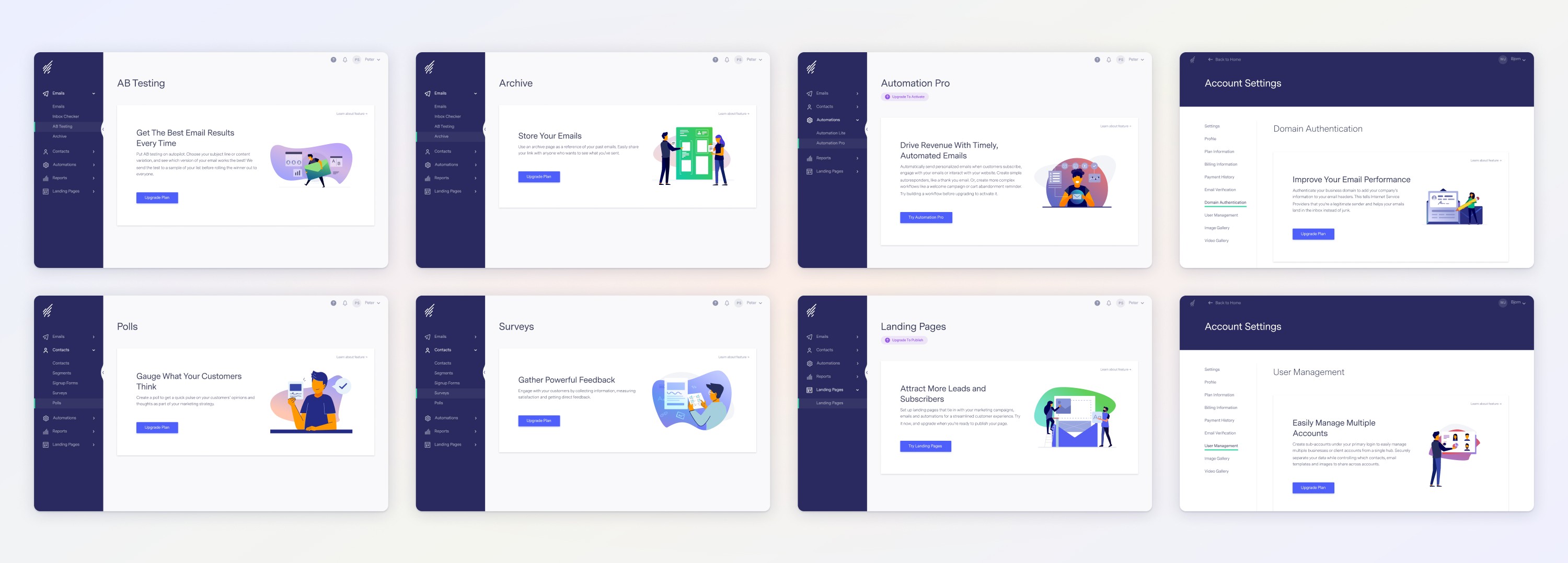
Designed visual language and messaging of feature gate upsells to align with marketing touchpoints
(above: restricted access and trial access features)

Modular system to handle different feature types and restriction combinations across legacy tech stacks

Created contextual upsells for smaller, restricted features and actions
Results And Impact
Increased Pro plan conversions and upgrades
By gearing new plans toward target SMB personas and empowering customers to independently adjust feature packages and contact limits, we increased Pro plan conversions by more than 25% and increased Pro plan upgrades by 50%.
25%
increase in Pro plan conversion
50%
increase in Pro plan upgrades
↑
elevated in-app traffic to key conversion pages
Reduced development time and operational costs by integrating with a feature management system
To reduce costs and mitigate deployment risks caused by the product’s legacy systems, I worked closely with engineers to unify 80% of features into LaunchDarkly’s centralized feature management platform.
This gave cross-functional product teams more control over feature flags, rapid experiments, progressive delivery, automated monitoring, and integration flexibility. It significantly reduced development time, surfaced post-launch priorities, and set the foundation for roadmapped features like multi-user management.